First Aid Kit Supplier vs Manufacturer: 12 Questions to Ask Before You Sign
A procurement manager receives five quotations for what appears to be the same first aid kit. Each includes a bag, dressings, bandages and gloves. Yet one quote excludes printed packaging, another allows component substitutions, and a third gives a production estimate without saying when the clock starts. The lowest unit price does not answer which offer meets the order requirements.
Quick answer: Choose a first aid kit supplier by confirming who manufactures and assembles the kit, which requirements apply to its contents and destination, how substitutions are approved, and how deliveries can be traced. Record the agreed specification, delivery milestones and quality responsibilities before committing to production.
The questions below help brands, distributors and institutional buyers turn a supplier shortlist into comparable proposals. They also explain how ORI-POWER combines manufacturing and sourcing support for different purchasing programs.
Already have a specification? Send ORI-POWER your contents list, destination country and order quantity for a project review.
First Aid Kit Supplier vs Manufacturer: What the Difference Costs You
A manufacturer can also be your supplier. The useful distinction is between the company selling the kit, the sites making its components, the business assembling it and the parties responsible for its market compliance.
Physical manufacturing and the regulatory role of manufacturer are not always identical. Private-label arrangements also need clearly assigned responsibilities. A business description such as "factory direct" does not settle these questions.
| Purchasing route | Potential benefit | Cost or limitation to examine | Responsibility to clarify |
|---|---|---|---|
| Direct manufacturer | Access to construction choices, assembly and repeat production | Setup charges, minimum quantities, import logistics and production scheduling | Manufacturing sites, outsourced processes, final release and defect handling |
| Trading company | Consolidated purchasing across several product categories | Service margin, source transparency and control over changes | Component sources, inspection ownership and corrective action |
| Stockholding distributor | Local availability, smaller orders and simpler replenishment | Catalog restrictions and cost per kit | Authentic sourcing, storage, remaining shelf life and recall communication |
| Brand owner | An established range and channel positioning | Branding restrictions, territory terms and customization limits | Legal manufacturer, distributor authorization and after-sales support |
Compare total delivered cost per accepted kit. Include the kit, development, packaging, inspection, freight, duties and receiving costs. Keep assumptions about defects or unused stock separate unless you have evidence to quantify them.

At ORI-POWER, these capabilities overlap. We manufacture carriers and medical consumables, assemble kits and coordinate additional sourcing through an established supplier network. Our own product ranges also support branded distribution. This allows a buyer to discuss custom production, sourced components and an existing brand range with one commercial contact. Learn more about ORI-POWER and its product ranges.
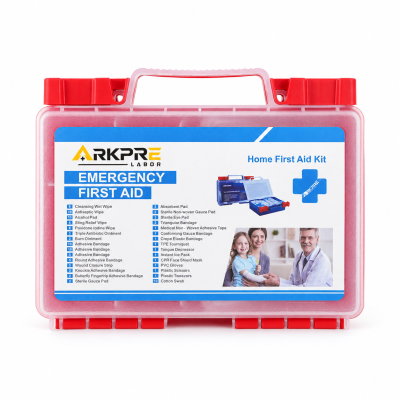
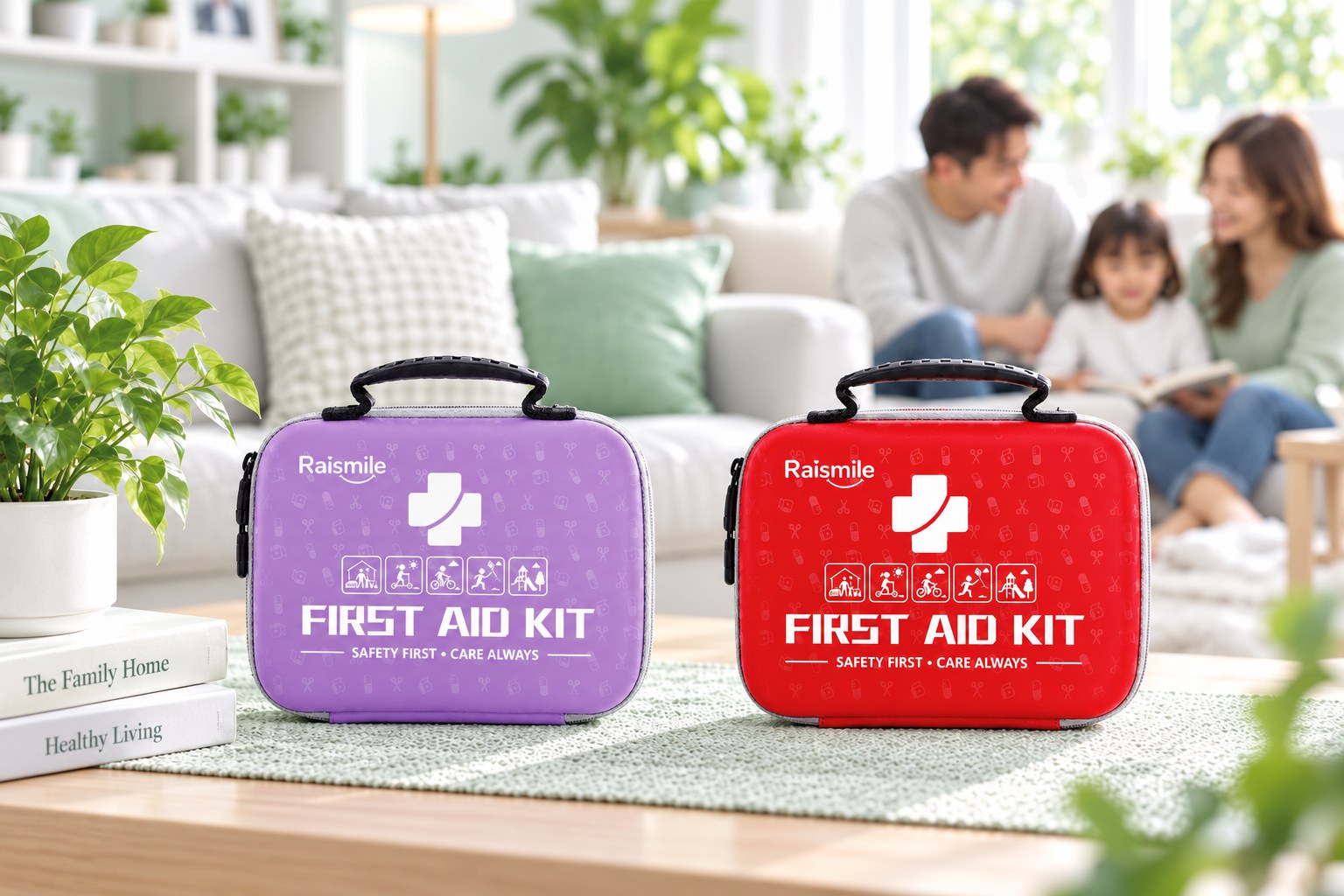
Our portfolio includes ARKPRE Tactical, Adventure, Labor and Drive — including our ARKPRE Labor workplace first aid kits — plus Raismile®Care and Benelinemed®Response. Select the range that matches the application, then confirm which parts of your proposed order are produced in-house or externally sourced.
12 Questions to Ask Every First Aid Kit Supplier on Your Shortlist
Use these questions at quotation stage. Some answers can be confirmed through public records and commercial correspondence; others require an agreed audit, sample evaluation or order-stage records. Establish when each item will be available and what must be resolved before production or shipment.
1. Who will manufacture, assemble and release this exact kit?
Ask for the contracting entity and the roles of the production and assembly sites. Identify externally sourced items and any outsourced processes relevant to the product, such as sterilization. Record who approves the finished kit for shipment and who will respond to a quality complaint. A factory photograph alone does not establish that the photographed site will make your order.
2. What exact specification does the price cover?
Request an itemized bill of materials with quantities, dimensions, materials, packaging and relevant product attributes. Identify sterile versus non-sterile supplies where applicable, plus the bag, instructions, labels and shipping cartons. "100 pieces" is not a sufficient specification. Piece-counting methods may differ, and equal counts can conceal different dressing sizes or quantities. Compare each line, then freeze an approved revision.
3. Can you support the selected products in our destination market?
State the country, intended use and sales channel. Ask which registrations, conformity documents, labels or other evidence are applicable and available for the proposed configuration. Separate the empty carrier, individual contents and assembled kit. A document covering one component does not automatically establish compliance of the complete assortment. Confirm availability before placing an order and agree on the applicable document-delivery stage.
4. What capacity can you allocate to our order?
Ask about available capacity for your particular configuration, not just total factory output. Printed packaging, special fabrics and externally sourced components may determine the delivery date. For repeat business, discuss forecast quantities, peak-season demand and replenishment lead times. Record whether the proposal includes reserved capacity or only an estimate based on current availability.
5. What factory assessment or sample evaluation can we arrange?
Discuss an on-site visit, third-party assessment or live production review appropriate to the order. Define its scope: sewing, assembly, receiving inspection, labeling or other relevant operations. For samples, compare the actual contents, carrier construction, label layout and packaging against the specification. An existing catalog sample can demonstrate a platform; a final approved sample should represent the agreed production configuration. Confirm sample charges, revisions and acceptance criteria.
6. What substitutions require our written approval?
Ask whether the supplier can change a component manufacturer, size, material, sterile status, packaging or label. "Equivalent quality" needs a written definition and a review process. A useful purchasing requirement is: proposed changes must identify the affected item, reason, specification differences and any implications for documentation or labeling. Require written approval before implementation and update the approved bill of materials where necessary.
7. How will you control batches and remaining shelf life?
Ask how the shipment links to assembly records and relevant component lots. Agree on the minimum remaining shelf life for dated supplies at a defined point, such as dispatch or delivery. Do not assume every component has the same expiry date. The identification and expiry presentation should suit the product and applicable requirements, while enabling the buyer to manage replenishment and investigate an affected batch.
8. What quality checks determine shipment acceptance?
Define checks for contents, quantities, labels, packaging integrity and carrier function. Agree on sampling, defect categories, acceptance criteria and what happens if inspection fails. Final inspection should complement incoming and in-process controls. Ask who investigates a failure, approves rework and verifies the corrected shipment. Decide which inspection arrangements and records form part of the order.
9. What starts the lead time, and what does the delivery date mean?
Clarify whether the quoted period begins after deposit, artwork approval, sample approval or material confirmation. Distinguish goods-ready date, shipment date and estimated arrival. Record the Incoterm, named place, agreed milestones and delay-notification process. A promise of "30 days" is incomplete if nobody has defined the start point or whether transport is included.
10. What are the MOQ and full commercial terms?
Check whether minimum quantities apply per model, color, contents configuration or printed packaging design. Confirm development fees, payment stages, carton quantities and freight assumptions. Request comparable quantity tiers for the same specification. A lower unit price should not quietly remove a component, reduce the agreed shelf life or change the packaging.
11. How will complaints, withdrawals and recalls be handled?
Ask for an escalation contact and an explanation of how affected orders would be identified. Discuss containment, investigation, customer communication and corrective action. Agree on commercial responsibilities for defective goods and recall cooperation, while recognizing that statutory duties depend on each party's role and market. For larger programs, a planned traceability exercise can test whether the proposed process works.
12. Can you support repeat orders, refills and controlled changes?
Ask how the supplier maintains your approved configuration and identifies revisions. Discuss refill availability, discontinued items and the notice period for a proposed change. For multi-site customers, decide whether every location receives the same SKU or documented variants. Consistency matters when purchasing staff reorder from an old quotation or users replace individual supplies.

First Aid Kit Supplier Red Flags: Lead Time, Substitution and Traceability
| Red flag | Why it affects the purchase | What to resolve |
|---|---|---|
| No usable batch linkage | An affected component may be difficult to connect to shipped kits | Agree on traceability appropriate to the products and verify the process |
| Substitution at the supplier's discretion | The delivered kit can differ from the approved specification | Require a documented approval process |
| Verbal delivery promise | The buyer and supplier may be measuring different milestones | Put the lead-time trigger and delivery milestone in writing |
The concern is not simply the absence of a particular batch-number format on the outer bag. Examine the complete identification and record system, together with any applicable labeling requirements.
Suppliers of First Aid Kits: How to Verify Certificates and Factory Audits
Start with the exact legal entity, site and scope. A valid credential for another company or an unrelated activity does not establish suitability for your order.
| Evidence | Verification route | What it does not establish by itself |
|---|---|---|
| ISO 13485 certification | Check certificate number, scope, site, status and issuer; use the issuer's verification service and IAF CertSearch where available | Approval of every product, or its performance under your use conditions |
| EU conformity evidence | Identify applicable legislation and product; review the declaration and relevant certificates; verify notified-body designation in NANDO where required | Blanket CE coverage for all kits and contents |
| FDA registration and listing | Check the official FDA database for the relevant entity and device information | FDA approval, clearance or authorization |
| Factory audit | Review date, site, audit scope, findings and corrective-action status through the agreed access arrangement | Permanent assurance that later orders meet the specification |
ISO 13485 concerns medical-device quality management, and ISO itself does not issue certification. IAF CertSearch can help verify accredited management-system certification status; if a result is unclear, contact the issuer rather than drawing a conclusion from a search alone.
For CE marking, determine whether third-party involvement is required under the relevant conformity route. Where it is, check that the notified body's designation covers the relevant legislation and activity. Voluntary certificates are not a substitute for the required conformity evidence.
FDA states that registration and listing do not mean approval and that it does not issue medical-device registration certificates. Avoid treating a decorative "FDA certificate" as proof of authorization.
There is no single validity period for every factory audit. A report records an assessment at a particular time. Review frequency depends on the audit scheme, buyer requirements, findings and subsequent changes. A site relocation or major process change may justify reassessment before an otherwise planned review date.
Confirm document availability before ordering. ORI-POWER provides relevant documents only to customers who have placed an order, subject to the products ordered and the applicable document scope. Send your destination country, selected products and required documents, and we will confirm whether corresponding documents are available. A pre-order enquiry confirms availability only; it does not include provision of the documents.
Medical First Aid Kit Suppliers vs General-Line Suppliers
Medical first aid kit suppliers should be evaluated on their control of the actual contents, particularly where sterile, dated or regulated products are involved. General-line suppliers can also be suitable if they maintain the necessary sourcing, storage and documentation arrangements.
| Purchasing concern | Evidence to seek from either supplier type |
|---|---|
| Sterile or dated components | Appropriate source controls, packaging integrity checks and expiry management |
| Mixed contents | Clear specifications and an assessment of the applicable requirements for each product |
| Private-label packaging | Approved artwork, defined responsibilities and controlled revisions |
| Storage and delivery | Conditions consistent with the supplied products and protection during transport |
| Refills | Replacement items that match the approved specification or follow the agreed change process |
The difference lies in demonstrated controls, not a supplier's category name. An established general-line distributor may suit local replenishment, while a manufacturer with component and assembly capabilities may better support repeated custom orders.
How to Identify the Best First Aid Kit Suppliers: A Weighted Scorecard
Use the scorecard below as an editable procurement tool. The weights are recommendations, not a standard, certification or ranking of named suppliers. First apply mandatory gates: confirmed product and market suitability; an acceptable plan for required documentation; an agreed specification; and workable substitution and traceability controls. An unresolved mandatory requirement cannot be offset by a low price.
| Criterion | Weight | Evidence to assess | Supplier A: 0-5 | Supplier B: 0-5 | Supplier C: 0-5 |
|---|---|---|---|---|---|
| Product and market suitability | 25 | Applicable requirements, public verification and document availability/scope | - | - | - |
| Quality and sample performance | 20 | Sample results, production controls and agreed inspection plan | - | - | - |
| Traceability and change control | 20 | Batch linkage, substitution approval and complaint process | - | - | - |
| Delivery and capacity | 15 | Order-specific schedule, material constraints and delivery evidence | - | - | - |
| Total delivered cost | 15 | Same specification, quantity, destination and commercial basis | - | - | - |
| Service and replenishment | 5 | Follow-up ownership, refill options and continuity planning | - | - | - |
| Total | 100 | Sum of weighted points | - | - | - |
Calculate each row as rating ÷ 5 × weight. A rating of 4 in a 20-point category contributes 16 points.
Use a consistent rating scale: 0 = unacceptable or no evidence; 1 = major gaps; 2 = partial support; 3 = meets agreed requirements; 4 = stronger relevant evidence; 5 = well-supported capability beyond the baseline that matters to your project. Mark information that is not yet available as pending instead of assuming a positive score. Revisit the score after sample evaluation and subsequent verification.
Keep an evidence note and evaluation date beside each rating. This makes the scorecard useful for purchasing decisions rather than simply rewarding the most persuasive sales presentation.
Wholesale First Aid Kits Manufacturer: When Factory-Direct Beats a Reseller
Factory-direct purchasing is most attractive when a stable specification, repeat volume and customization needs justify production setup and import coordination. A reseller can remain competitive for small, urgent or mixed orders held in local stock. There is no universal order quantity at which direct purchasing becomes cheaper. Compare actual quotations on the same delivered basis.
For illustration only, suppose a direct project has a $600 setup charge and a comparable variable delivered cost of $8 per kit. A reseller quotes $10 per kit with no setup charge. The mathematical crossover is:
$600 ÷ ($10 − $8) = 300 kits.
At 300 kits, both options total $3,000. This is a hypothetical calculation, not an ORI-POWER quotation or an industry benchmark. It applies only if both offers are genuinely comparable and the factory accepts that quantity. Minimum orders, unused inventory, financing and quality-related costs can change the decision.
ORI-POWER's contact page lists standard orders from 100 sets and OEM orders from 500 sets. Confirm the selected product, color, packaging and contents before using these starting points in a budget.
How ORI-POWER Supports a Supplier Evaluation
Our manufacturing capabilities include soft carriers, hard cases, medical consumables and kit assembly. This can help buyers coordinate the carrier and contents within one production brief. Explore our capabilities as a first aid kit manufacturer and identify the processes relevant to your order.
Our supply-chain program describes supplier qualification, incoming inspection, material-lot linkage and planning for dated components. Discuss your required specification, sourced items and replenishment forecast with our team so the proposal can reflect those needs. See our first aid kit supply chain approach.
Buyers seeking an existing branded range can also explore the first aid kit distributor program. Agree on product availability, channel fit and commercial terms for the selected range.
Frequently Asked Questions
Is a trading company always more expensive than a manufacturer?
No. Consolidation, available stock and local logistics can offset a trading company's margin. Compare the full delivered cost and service scope for the same configuration.
How long is a factory audit report valid?
There is no universal period. Check the scheme or buyer policy, assessment date, findings and changes since the audit. A report should be considered alongside current production evidence.
Can small orders receive factory pricing?
Sometimes, particularly for an existing configuration. However, a small custom order may carry setup or packaging costs that increase its unit price. Ask for both a standard-platform option and a custom option.
Can ORI-POWER supply items it does not manufacture itself?
We can discuss additional sourcing through our supplier network. Send the required specification so availability, source controls and inclusion in the final kit can be confirmed. Sourcing support does not mean every requested item is automatically available.
Can I receive compliance documents before placing an order?
ORI-POWER provides relevant documents only to customers who have placed an order, within the scope applicable to their ordered products. Before ordering, send your target country and product requirements to confirm whether the corresponding documents are available.
Discuss Your First Aid Kit Order with ORI-POWER
Send your destination country, intended application, quantity and contents list. Indicate whether you need an existing branded kit, private labeling or a custom configuration. If your specification is still developing, include a reference image and the items you already know you need.
Use the scorecard in this guide to compare proposals, and ask our team to confirm the proposed manufacturing and sourcing scope, MOQ, sample plan, delivery milestones and target-country document availability.
Send your requirements for a project-specific quotation and sample plan.
Send an InquirySources and Editorial Scope
Sources reviewed November 26, 2026. The questions, weights and cost example are editorial procurement tools. Supplier capabilities are based on ORI-POWER's published information; this article does not claim an independent factory audit or verification of every product certificate. Product requirements and document availability depend on the final configuration and destination.
- ORI-POWER — First aid kit manufacturing
- ORI-POWER — Supply chain management
- ORI-POWER — Product ranges and company overview
- ISO — ISO 13485 and certification
- IAF CertSearch — Certificate verification guide
- European Union — Conformity assessment
- FDA — Registration and certification claims
- ORI-POWER — Ordering and contact information
- ORI-POWER — First aid kit distributor program